


Hi, I'm James Mang

I am a sixth-year Astronomy graduate student and NSF Graduate Research Fellow at the University of Texas at Austin working with Prof. Caroline Morley. I'm interested in the characterization of exoplanet atmospheres to deepen our understanding of these distant worlds.

If you are interested in my work or potential collaborations, please take a look at my CV or contact me!

About Me

I study the atmospheres of ultra-cool brown dwarfs and temperate giant exoplanets. I'm interested in how their chemistry, clouds, and atmospheric dynamics shape the spectra we see. With JWST, we are now directly imaging benchmark systems that approach true Solar System analogs, and I use these objects to better understand the diversity and formation of cold substellar objects.

My current work focuses on water cloud formation in these cold atmospheres and how it impacts observations. I also develop open-source frameworks like PICASO, and generate atmospheric models to interpret JWST data and prepare for future observations with the Nancy Grace Roman Space Telescope and upcoming Extremely Large Telescopes.

James MangHeadshot

Education

2021, University of California, Berkeley

B.A., Astrophysics

B.Sc., Chemistry

Mentor: Dr. Peter Gao

2024, The University of Texas at Austin

M.A., Astronomy

Thesis: Microphysical Prescriptions for Parameterized Water Cloud Formation on Ultra-cool Substellar Objects

Advisor: Dr. Caroline V. Morley

Expected 2027, The University of Texas at Austin

Ph.D., Astronomy

Dissertation: Understanding Ultra-Cool Substellar Atmospheres in the Era of JWST

Advisor: Dr. Caroline V. Morley

My Research

Studying H2O Cloud Formation & Properties

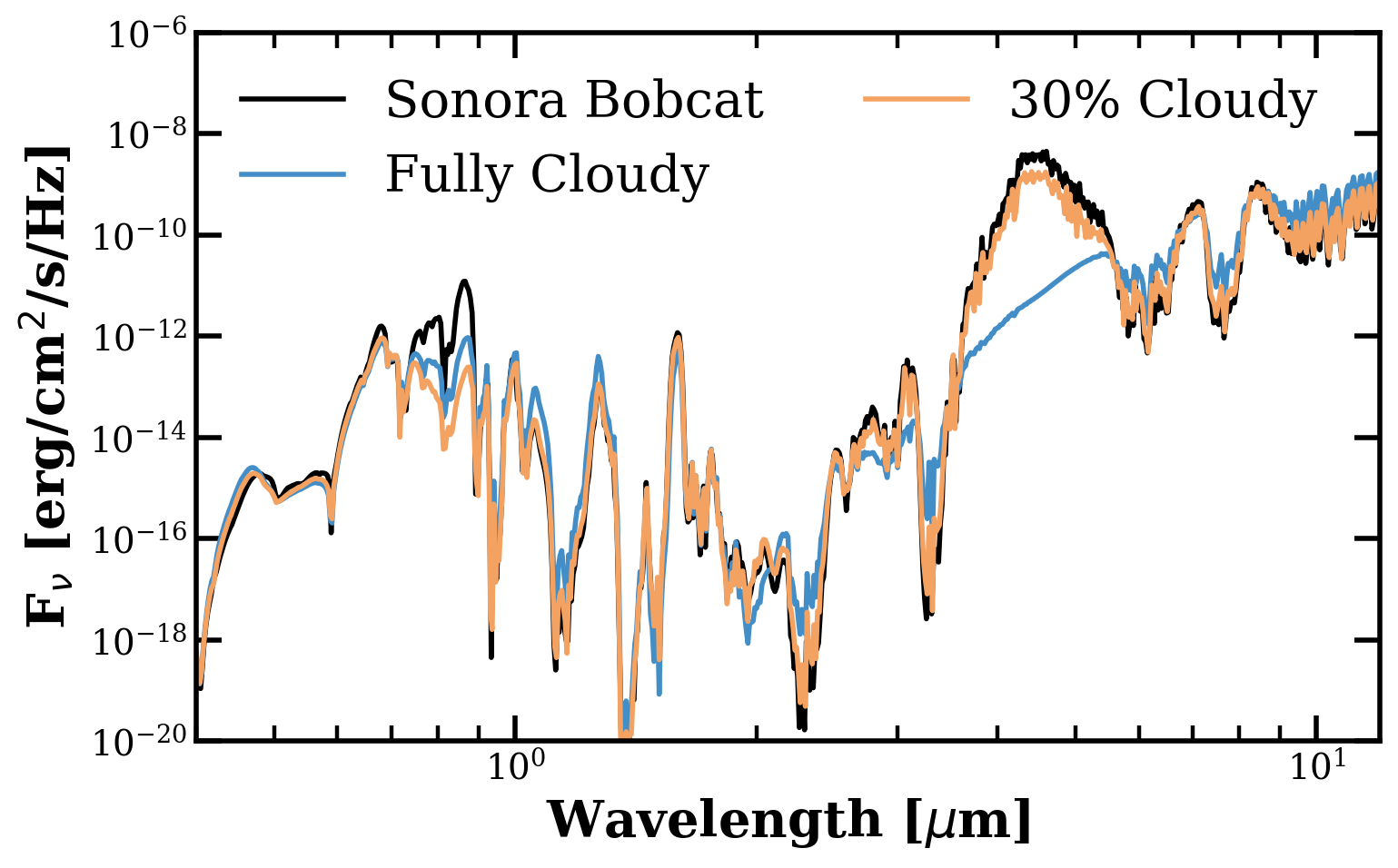
Water clouds are expected to form in cool brown dwarfs and giant planets with Teff < 450 K. Cloud distributions are controlled by microphysical processes such as nucleation and condensation, which hasn't been considered in detail for water clouds in H/He atmospheres. In the first paper (left), I investigate the impact of including microphysical water clouds in the atmosphere. In the second paper (right), I provide recommendations for the best practices to include water clouds in these atmospheres when using parameterized cloud models. Our results are the first step towards constraining water clouds' impact on cooler worlds to inform observations by JWST.
Cloud model figure from PICASO workPICASO figure

Developing Climate Modeling Tools

I am committed to open science and developing open-source software that enables others to validate, reproduce, and build on our work. In this spirit, I was the lead developer of PICASO 4.0, the latest version of the climate modeling and spectral synthesis framework. PICASO 4.0 is a fully open-source, self-consistent, cloud-coupled climate modeling framework. It also introduces new capabilities, including flexible chemical prescriptions, photochemistry, and parameterized external energy injection. For more details on these updates, see the paper below.

Sonora Flame Skimmer spectral sequence (Mang et al. 2026, Fig. 6)Flame Skimmer figure

Generating Atmospheric & Evolutionary Models

Using PICASO, I am developing the next generation of Sonora models, Sonora Flame Skimmer. This new grid is designed to interpret the unprecedented detail revealed by JWST observations of ultra-cool substellar objects, including newly imaged planets that resemble the gas and ice giants in our Solar System. Sonora Flame Skimmer extends to temperatures as low as 50 K and surface gravities down to log(g) = 2, spanning a wide range of metallicities ([M/H] = −1 to +2) and including both equilibrium and disequilibrium chemistry.

WISE 1935 pressure-temperature profiles with auroral energy injection (Zuckerman et al. 2026, Fig. 4A)
Aurora figure

Investigating Heating Mechanisms of Isolated Brown Dwarfs

Early JWST observations of the coldest brown dwarfs have revealed surprising features, including CH4 seen in emission. This was first identified in WISE 1935, an isolated brown dwarf, and similar signs of a thermal inversion have been suggested in the T dwarf SIMP 0136. Methane emission indicates that the upper atmosphere is being heated but the source of that heating remains unclear. My work explores whether aurorae could be responsible. I use atmospheric models that simulate energy deposition from electron beams, similar to auroral processes, to test whether they can provide enough energy to heat the upper atmospheres of objects like WISE 1935 and reproduce the observed thermal inversions.

Selected Publications

By the Numbers

  • 5First-Author Publications
  • 41Total Publicationsincl. 12 in review
  • 83First-Author Citations
  • 767Total Citations
  • 14Total h-index

First-Author Papers

  1. Zuckerman, A.† & Mang, J.†, Pineda, J.S., Morley, C.V., et al. (2026) Can Auroral Heating Explain Brown Dwarf Thermal Inversions?. ApJ, 1010, 222.
  2. Mang, J., Chachan, Y., Morley, C.V., Batalha, N.E., et al. (2026) The Sonora Substellar Atmosphere Models. VII. Flame Skimmer: Cloud-free Atmospheric and Evolutionary Models for the Coldest Substellar Objects. ApJ, 1008, 254.
  3. Mang, J., Batalha, N.E., Morley, C.V., Wogan, N.F., et al. (2026) PICASO 4.0: Clouds and Photochemistry in Climate Models of Brown Dwarfs and Exoplanets. ApJ, 1000, 98.
  4. Mang, J., Morley, C.V., Robinson, T.D., Gao, P. (2024) Microphysical Prescriptions for Parameterized Water Cloud Formation on Ultra-cool Substellar Objects. ApJ, 974, 190.
  5. Mang, J., Gao, P., Hood, C.E., Fortney, J.J., Batalha, N., Yu, X., de Pater, I. (2022) Microphysics of Water Clouds in the Atmospheres of Y Dwarfs and Temperate Giant Planets. ApJ, 927, 184.

† Co-first authors (equal contribution)

Second/Third-Author Papers

  1. Miles, B.E., Mang, J., Morley, C.V., Skemer, A.J.I., et al. (2026) Water Cloud and Chemical Modulations in the Coldest Brown Dwarf. AJ, accepted.
  2. Llop-Sayson, J., Fogal, A., Mang, J., Thompson, W., et al. (2026) An Updated Model for ε Eridani b and Prospects for Imaging with the Roman Coronagraph. AJ, 172, 292.
  3. Jenkins, S.A., Vanderburg, A., Mang, J., Becker, J., et al. (2026) Atmospheric Signatures of Common Envelope Evolution in White Dwarf Planets. ApJ, 1006, 241.
  4. Sanghi, A., Thompson, W., Mang, J., Xuan, J., et al. (2026) Worlds Next Door. IV. Mapping the Late Stages of Giant Planet Evolution with a Precise Dynamical Mass and Bolometric Luminosity for the Benchmark Cold Gas Giant ε Ind Ab. AJ, 172, 115.
  5. Matthews, E.C., Mang, J., Carter, A.L., Mâlin, M., et al. (2026) A second visit to Eps Ind Ab with JWST: new photometry confirms ammonia and suggests thick clouds in the exoplanet atmosphere of the closest super-Jupiter. ApJL, 1002, L5.
  6. Sanghi, A., Mang, J., Llop-Sayson, J., Mamajek, E.E., et al. (2026) Worlds Next Door. III. Indirect Evidence for Enhanced Atmospheric Metallicity or the Presence of Water Clouds in the Nearest Jupiter-analog ε Eri b. AJ, 171, 225.
  7. Bowens-Rubin, R., Mang, J., Limbach, M., Carter, A.L., et al. (2025) NIRCam yells at cloud: JWST MIRI imaging can directly detect exoplanets of the same temperature, mass, age, and orbital separation as Saturn and Jupiter. ApJL, 986, L26.